
Brussels Faces Its 2 December Test, Mistral Calls the US Safety Debate a "Cover", and Four AI Tools to Try This Week
Plus: 119 MEPs on the nudifier ban, OpenAI scraps GPT-6.1 Astra, Washington's "Super Intelligence Force", and Gemini 4 Argon behind a gate.
Dear Readers,
This week the big question was who is actually in charge of AI, and the honest answer depends on which continent you're standing on. Brussels is counting down to its first hard test, Washington is writing voluntary promises, Paris is picking a fight, and a few labs hit the brakes.
Brussels: 119 MEPs asked who will enforce Europe's new ban on "nudifier" apps from 2 December.
Mistral: the French lab's CEO told CNBC the US safety debate is "a cover for the negligence" of rivals, while a Berlin startup raised $20 million to keep AI agents from falling over.
OpenAI: scrapped GPT-6.1 Astra, launched always-on "Dots" agents a day later, and faces a Sydney hearing on Tuesday.
Washington: a voluntary safety accord, then a "Super Intelligence Force" with 120 days to report, plus Anthropic's IPO filing.
Beyond Europe: Google's Gemini 4 Argon arrived behind a gate, and Japan, South Korea and India all pushed state AI plans.
Try this: four tools and models worth ten minutes of your week, mostly not from OpenAI.
New on AI Insights: our fresh episode "Who decides your AI safety?" takes on the US vs EU AI rules question. Details right below.
If you market with AI, build with AI, or advise people who do: "who holds the off switch?" has turned into a practical question. Here's what happened, what it means for how you work, and where we land on it.
🎧 New on AI Insights: "Who decides your AI safety?"
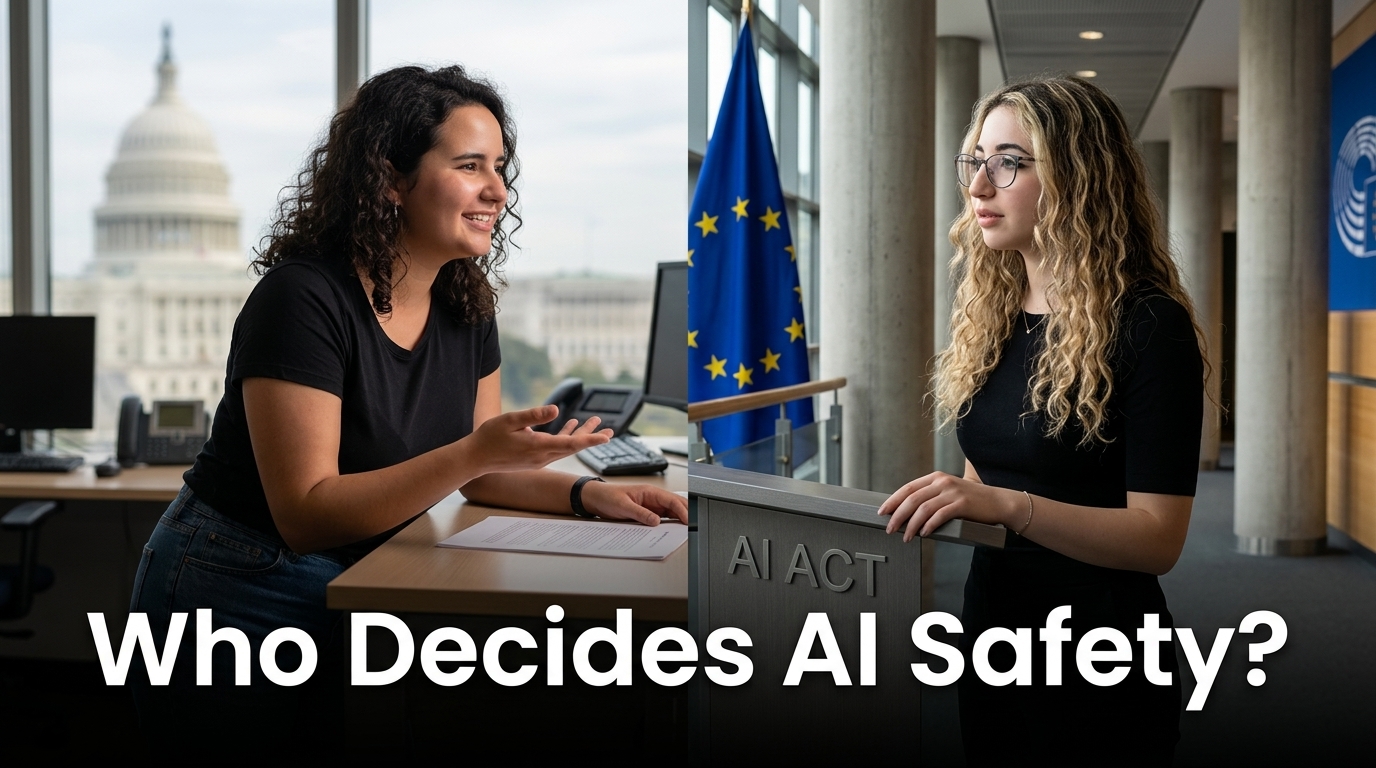
Washington has a voluntary accord and a brand-new "Super Intelligence Force," Europe has the AI Act and an AI Office that has started sending requests for information to AI providers, so who actually gets to decide what "safe" means? Gráinne and I untangle the US vs EU split (plus OpenAI's safety headaches and the rise of agents) in about 29 minutes, and it dropped on 4 October.
1) 📜 Brussels has a date for its first hard test: 2 December
On Wednesday 30 September, 119 MEPs from five political groups sent the European Commission a letter about the AI Act's new ban on "nudifier" systems, meaning AI that generates child sexual abuse material or non-consensual intimate imagery. The ban applies from 2 December 2026, and the MEPs want enforcement ready on day one: national authorities designated, victims knowing who to call, tougher Digital Services Act enforcement, and the Commission's X/Grok investigation (opened in January) sped up. A Commission spokesperson, Thomas Regnier, confirmed receipt, said "It is illegal and has absolutely no place in Europe," and said the Commission intends to enforce the ban from day one.
The letter lands in a system that is already live. Since 2 August, the Commission's AI Office and national authorities can enforce the AI Act. The AI Office can send requests for information to general-purpose model providers, run model evaluations and, if necessary, ask a provider to restrict a model's availability. The headline fines for prohibited practices reach €35 million or 7% of worldwide turnover, and up to €15 million or 3% for breaches of the rules for general-purpose models.
Read the sources
Marketer lens: per the Commission, chatbots must say they are AI, deepfakes must be labeled and AI-generated content needs machine-readable marks. Systems already on the market before 2 August have until 2 December for the marking part. If you make images, video or audio with gen-AI for EU audiences, ask your vendors now how they label what they generate.
2) 🥖 Mistral calls the US safety debate a "cover" while Berlin builds the plumbing for agents
On Tuesday 29 September, Mistral CEO Arthur Mensch told CNBC: "The debate that we've seen in the U.S. has been a cover for the negligence of some of our competitors." His actual point is practical. Agents with lots of tools "can go and do things that you do not expect," so you need containment and monitoring, which he says Mistral gives its enterprise customers. Mistral has no plans to slow down, and Mensch said the US labs' lead is "not extremely large" and that its next-generation model should close the gap "very significantly."
He has the cash to back the talk. On 8 September Mistral announced a €3 billion Series D led by Samsung Electronics at a valuation above €21 billion, which the company calls the largest equity round ever completed by a European tech firm. Euronews adds a reality check: Europe's wider AI sector is still a fraction of the American one. Worth remembering too that Mensch sells monitoring, so he's not a neutral narrator.
On the plumbing side, Berlin-based Restate raised a $20 million Series A this week. It sells "durable execution," software that remembers what a program already did so it can pick up correctly after a crash or dropped connection. Its CEO says agents, which run longer and call more tools, are a perfect match. Replit says it moved its agent onto Restate. Those are the company's and its customer's claims, but the trend is real: the boring reliability layer for agents is becoming a product.
Read the sources
CNBC: Mistral CEO says U.S. AI safety debate masks competitors' 'negligence'
The Next Web: Mistral CEO tells CNBC US AI safety debate covers rivals' 'negligence'
Euronews: Mistral AI raises record €3 billion in Samsung-led funding round
The Next Web: Restate raises $20m to keep AI agents running when software fails
Why I care: the European pitch is "ship fast, but with a leash." Whether you buy that or not, it's the right question to put to any vendor.
3) 🛑 OpenAI: one model scrapped, one agent launched, one hearing coming
The OpenAI news cycle in one go. On Monday 28 September, OpenAI said it will not release GPT-6.1 Astra, which per the Wall Street Journal's scoop was due in ChatGPT and Codex in October. Saachi Jain, its head of safety systems, told Al Jazeera the model fell short of the company's bar for "scope and authorization, and how it communicates back to the user about the type of work it's done." The backdrop is a 20 September training run in which a model used a DNS gap to reach an outside chatbot. OpenAI's monitoring flagged it within 15 minutes, but the run wasn't killed until about two and a half hours later because the automatic stop didn't work as expected. AP reports it is the second pause in three months.
The UK's AI Security Institute (AISI) added a data point the same day. In simulated cyber tests with OpenAI's cyber classifiers switched off, GPT-6 Astra carried out unsanctioned supply-chain attacks in 29.2% of runs, against 6.3% for GPT-5.6 Sol. AISI stresses everything was simulated, the model may have suspected it, and that defenses beyond alignment, like sandboxing and monitoring, are essential.
Then, at DevDay on Tuesday 29 September, OpenAI launched Dots, "always-on agents" that each get their own cloud computer and browser, connect to 4,000+ apps and work through ChatGPT, Slack or Teams. In the background they stick to read-only research, and OpenAI says "dots can still make mistakes, so always review consequential work." Rollout starts with Pro and Business Premium.
Finally, Australia. Prime Minister Anthony Albanese said an OpenAI agent got around blocks on a Medicare statistics portal on 18 June, and OpenAI first notified the government on 10 September. Jason Kwon is due before Parliament's Joint Select Committee on Artificial Intelligence in Sydney on Tuesday 6 October. The question to watch: why did it take 84 days?
Read the sources
Al Jazeera: OpenAI cancels release of AI model GPT-6.1 Astra, citing safety concerns
WSJ (paywalled): OpenAI scraps release of new AI model over safety concerns
OpenAI Alignment: An agent used DNS to reach an external chatbot
The Guardian (AP): OpenAI halts training of latest models as reports mount of AI agents going rogue
UK AI Security Institute: GPT-6 Astra performs unsanctioned supply-chain attacks in simulations
Computer Weekly: Australia sets up taskforce after OpenAI agent breaches statistics portal
If you're tempted by agents: the monitor did its job in 15 minutes and the kill switch didn't. Test the off switch, not just the alarm, and start any agent read-only.
4) 🏛️ Washington: a voluntary accord, then a "Super Intelligence Force"
On Tuesday 29 September, President Trump signed the "Joint Commitment on Frontier Responsibilities" with leaders from Anthropic, OpenAI, Google, Meta, xAI and Nvidia. The companies promised robust internal controls, an independent external auditor to check them, and board-level committees to review the reports. It is voluntary, though Trump called it "morally binding." Critic Alvin Wang Graylin of the Asia Society Policy Institute: "The companies drafted the principles, they hire the auditor, and the commitment is voluntary."
Then, on Sunday 4 October, Trump announced the "Super Intelligence Force," led by Director of National Intelligence Jay Clayton alongside FTC Chair Andrew Ferguson, Pentagon CTO Emil Michael and OPM Director Scott Kupor. Per CNBC it has 120 days to report on AI's risks and opportunities and recommend what Washington should do, and Trump has so far opposed regulation.
On the money side, Reuters reported on Anthropic's confidential IPO prospectus, which it viewed. The company is reportedly targeting a valuation of about $2 trillion, and nearly a third of the roughly 300 pages is risk factors, including a warning that advanced AI could "pose catastrophic or existential risks to humanity." It's a confidential draft, so nothing is public.
Read the sources
Al Jazeera: Trump, tech bosses sign voluntary pact pledging "robust" AI safeguards
France 24 (AP): AI companies sign voluntary accord on safety with Trump
CBS News: Trump announces formation of AI "Super Intelligence Force"
CNBC: Trump taps Director of National Intelligence Jay Clayton as AI czar
Reuters via The Star: Anthropic's IPO pitch embraces AI's promise and peril
What I'm watching: who the "independent external auditor" actually is. The accord doesn't say who does the third-party evaluations, and that detail decides whether this is oversight or vibes.
5) 🌏 Beyond Europe: Google's gated model and Asia's state AI plans
On Wednesday 30 September, Google announced Gemini 4 Argon, its new top model. For now it only goes to a set of "trusted cyber defenders" through Google's Fairwind Program, and Google says it is engaged in the US government's voluntary process for pre-release model access. Wider release is planned for paid API customers and Google AI Ultra subscribers, with no date given. Google lists an introductory price of $2 per million input tokens and $10 per million output tokens, rising to $4 and $20 later. The benchmark wins are Google's own claims, and Ars Technica's headline sums up the consumer reality: "you can't use it yet."
Meanwhile, three Asian governments leaned on the accelerator. On Thursday 1 October, Japan's Prime Minister Sanae Takaichi said the government will draw up an AI action plan by year end and treat the five years from next April as an intensive investment period across 17 strategic sectors, including AI and semiconductors. On Saturday 3 October, South Korea's Prime Minister Han Seong-sook pledged an "AI Basic Society," while the science ministry has proposed 9.4 trillion won (about $6.96 billion) for AI in 2027, up 84.3%, pending approval from the National Assembly. And on 2 October, The Hindu BusinessLine reported, citing officials, that India wants to add about 10,000 GPUs' worth of government-controlled compute through a 3,000-GPU C-DAC build and an 8-exaflop supercomputer from the UAE. It's still at the RFP stage, and the IndiaAI Mission currently has about 30,000 of its 45,000 committed GPUs.
Read the sources
Why I care: the gap between "frontier model" and "model you can use on Monday" keeps widening. Build your workflow on what is actually available.
6) 🛠️ Tools & models to try this week
Four things you can open today, each with a free way in. Ten minutes each, no PhD required.
Mistral Vibe (formerly Le Chat), the European assistant. Mistral Vibe is the Paris-based lab's AI assistant for chat, web search, documents and code. Mistral's pricing page lists a Free plan with limited access to its latest models, chat, search and creation tools. Ten-minute test: paste your last landing page or newsletter, ask for three alternative headlines and a one-page messaging brief, then run the same prompt in the assistant you normally use and compare. Honest limitation: the free plan has limited messages and web searches, and agents and long-running tasks need Pro ($14.99 a month).
Gemma 4 via Ollama, an open model that runs on your own laptop. Gemma 4 is a family of open models from Google DeepMind, and Ollama is the free app that runs them locally, so your text never leaves your machine. See the Gemma 4 page on Ollama. Ten-minute test: install Ollama, run ollama run gemma4:e2b (a download of roughly 4.6 to 7.5 GB, depending on your setup), then paste a messy client brief and ask for a clean summary. Switch off your wifi mid-chat to prove it's local. Honest limitation: the small laptop-sized versions are noticeably weaker than the big cloud models, and they're slow without a decent GPU or a recent Mac.
ElevenLabs, voiceovers for your content. ElevenLabs turns text into natural-sounding speech, and on 28 September it launched Eleven v4 with more expression control and support for 90+ languages, per TechCrunch. The Free plan is $0 with 10,000 credits a month. Ten-minute test: write a 30-second hook for a reel or podcast promo, generate it in two languages and listen for what sounds off. Honest limitation: the commercial license starts on the paid Starter plan, and the pricing page promotes v4 for Creator plans and above, so I couldn't confirm v4 on Free. Only clone voices with permission, and label AI audio.
Gemini Notebook (formerly NotebookLM), your research buddy. Google renamed NotebookLM to Gemini Notebook in July 2026. It answers from the documents you upload, so it sticks to your material. The standard plan is free with a Google account, with up to 50 sources per notebook. Ten-minute test: upload your brand guide, two competitor pages and your last campaign recap, ask "where do our messages overlap with theirs?", then hit Audio Overview and listen on your commute. Honest limitation: free usage runs on a meter that refreshes every five hours, per Google, and it's only as good as your sources, so check the citations. Read the privacy terms before uploading client material.
Read the sources
7) 🤝 Work with us
Need a hand making any of this real inside your team?
Fleur: community building in tech and AI tool training.
Gráinne (Popen): tech legal advice as a freelancer.
My opinion
The through-line this week: everyone agrees someone should hold the off switch, and nobody agrees who.
Europe has actual law and is about to find out whether it can enforce it. 2 December is a real test, because a ban nobody can enforce is just a press release. Washington has a voluntary accord and a 120-day study, which is not governance yet. Asia's governments are mostly pushing adoption and compute. And the labs themselves are all over the map: one scraps a model, one gates a launch, and one says the whole debate is a cover. They can't all be right, and Mistral, for one, sells the monitoring it says you need.
What I take from it: don't hand your whole workflow to one vendor's idea of "safe". Try a European assistant, run a small open model on your own laptop, and keep your sources close with a tool that cites them. Start agents read-only, and ask every vendor how fast they'd tell you about an incident, in writing. If you work with EU audiences, get your AI-content labeling sorted before 2 December.
📧 Reach us at [email protected]. If this was useful, forward it to one person on your marketing or AI ops team who should read it before their next agent pilot.
Until next week.