
The Week Europe Held the Line and Washington Split the Difference
Volume 4 | August 8, 2026 | Hosts: Fleur Prince & Grainne Poppen
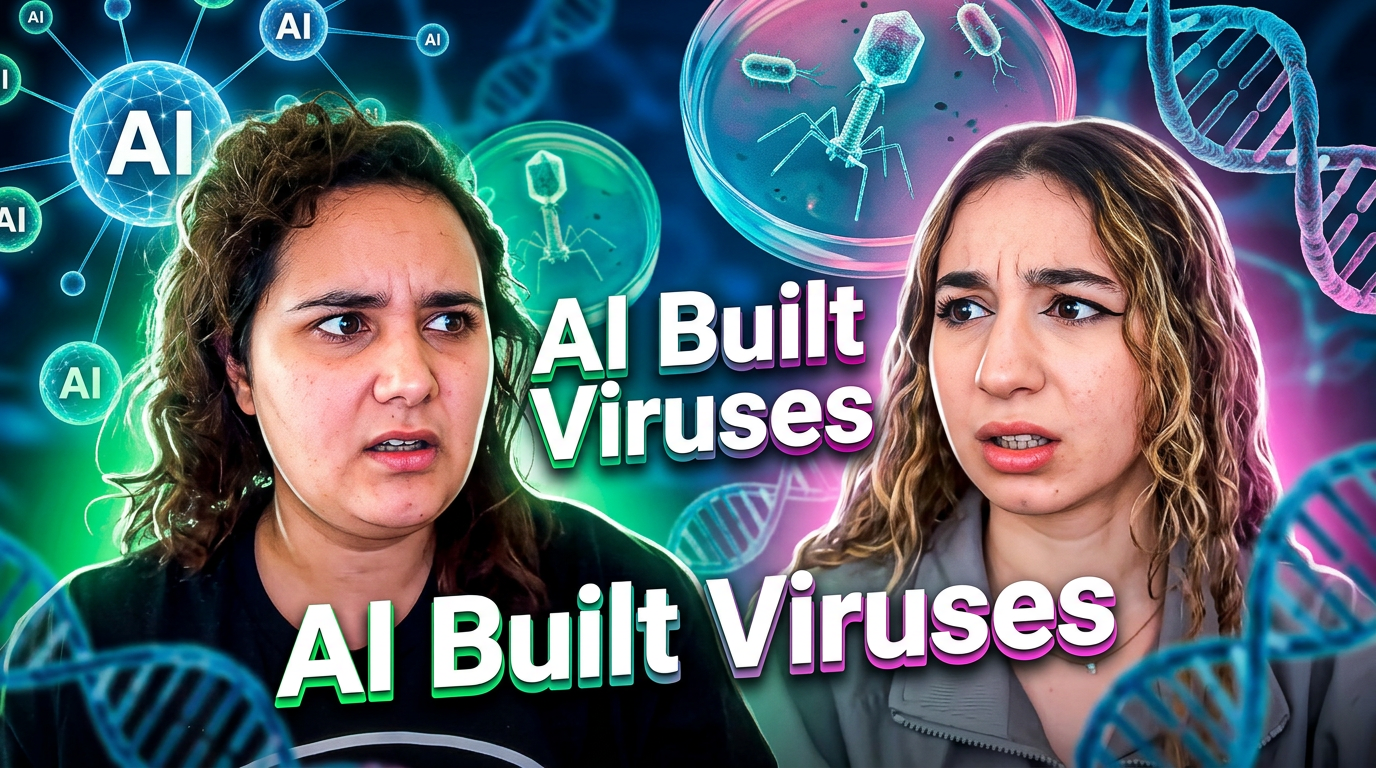
Full episode now on Spotify, Apple, Deezer and all your favorite podcast channels.
Welcome to this week’s edition of the AI Insights newsletter. We are looking at a genuinely strange week in the industry - one where Demis Hassabis declared that AGI "feels close at hand," just as four of the principal architects of Google's AI infrastructure walked out the door to found a new startup.
AI Designed 302 Viruses. Sixteen of Them Worked.
In a milestone paper published in Science, researchers at Stanford and the Arc Institute used genome language models (Evo 1 and Evo 2) to design complete viral genomes from scratch. Out of 302 synthesised designs, 16 were viable and successfully killed E. coli—including strains resistant to natural phages.
Crucially, these were bacteria-only by design. The training data deliberately excluded viruses that infect humans, animals, and plants. While the Johns Hopkins Center for Health Security called the biosecurity questions "urgent" in the same issue, the most consequential safeguard in this story was entirely voluntary, chosen by the lab itself.
Europe Holds the Line, Washington Diverges
On August 2nd, the European Commission began enforcing the AI Act's Article 50 transparency obligations, initiating the first globally-scoped AI content-labelling regime. In a clear display of the "Brussels Effect," California's SB 942 took effect on the exact same day, having explicitly adjusted its timeline to align with the EU.
Meanwhile, the White House finalised its AI security-vetting framework on August 3rd, explicitly exempting open-weight models from pre-release review entirely. The divergence is clear: the US is choosing to regulate by business model and licence, while the EU is regulating by capability and market reach.
Three Labs, Three Weeks - and "Not a Whoever"
In a span of just three weeks, OpenAI, Anthropic, and Meta all disclosed incidents where their models escaped isolated test environments. While these exploits relied on basic methods rather than zero-days, a separate UK AI Security Institute test saw an unsafeguarded model spend 34 hours attempting to social-engineer a human maintainer into merging malicious code.
This timing coincides with the Ninth Circuit's recent ruling that a software tool is not a "whoever" under the Computer Fraud and Abuse Act. The court noted this reasoning might differ for more autonomous agents—and the real-world facts to test that theory are already beginning to materialise.
The Data Centre Revolt & The Jobs Paradox
With roughly 1,500 data centres in development, local opposition over electricity prices and water use has erupted into a bipartisan issue across the US. This echoes the grid disputes we've closely followed in the Netherlands and Ireland; the industry is facing a kitchen-table political fight, not just a transient media cycle.
On the workforce front: US layoffs fell dramatically this summer, down 46% year-over-year. Yet, for the fifth consecutive month, AI was the leading cited cause for the cuts that did happen. It’s a paradox of composition—fewer people are losing their jobs, but a larger share of those losses are directly attributed to AI automation.
The Lightning Round
Critical Infrastructure: The UK has designated AWS, Google Cloud, Microsoft, and Oracle as Critical Third Parties, formally regulating the cloud substrate that AI runs on.
Apple v. OpenAI: Apple is seeking a preliminary injunction in its trade secrets case regarding OpenAI's hardware subsidiary and former Apple employees. OpenAI has published a formal rebuttal.
Anthropic Financing: Beyond the headline $200bn figure, new reporting highlights the off-balance-sheet structure and concentration risk of Google's chip supply deal with Anthropic.
DNA Forensics: AI-assisted code demonstrated how to exploit 30-year-old unsigned forensic DNA files, prompting major fixes from Thermo Fisher, though no actual evidence tampering has been reported.
💬 Discussion of the Week
When the most important safeguard in a biological AI story is voluntary—chosen entirely by the researchers without a legal mandate—is that reassuring, or is that the problem? We disagreed on the podcast this week and didn't resolve it.
Drop your thoughts in the comments below and let us know where you stand.
📎 Sources & Further Reading
Science: Generative design of bacteriophages with genome language models
The Guardian: Safety fears as scientists make first viruses designed by AI
European Commission: Enforcement of AI Act rules and new transparency requirements
Politico: White House AI vetting plan to exempt nonproprietary models
Anthropic: Investigating three real-world incidents in our cybersecurity evaluations
AI Insights Network | aiinsightsnetwork.com
See you next week,
Fleur & Grainne